Jenga Classic at a Glance
Jenga Classic Review: Is This Classic Wooden Stacking Game Still Worth It?
Affiliate Disclosure: This post contains affiliate links. If you purchase through one of the links, OzoneShip may earn a commission at no additional cost to you.
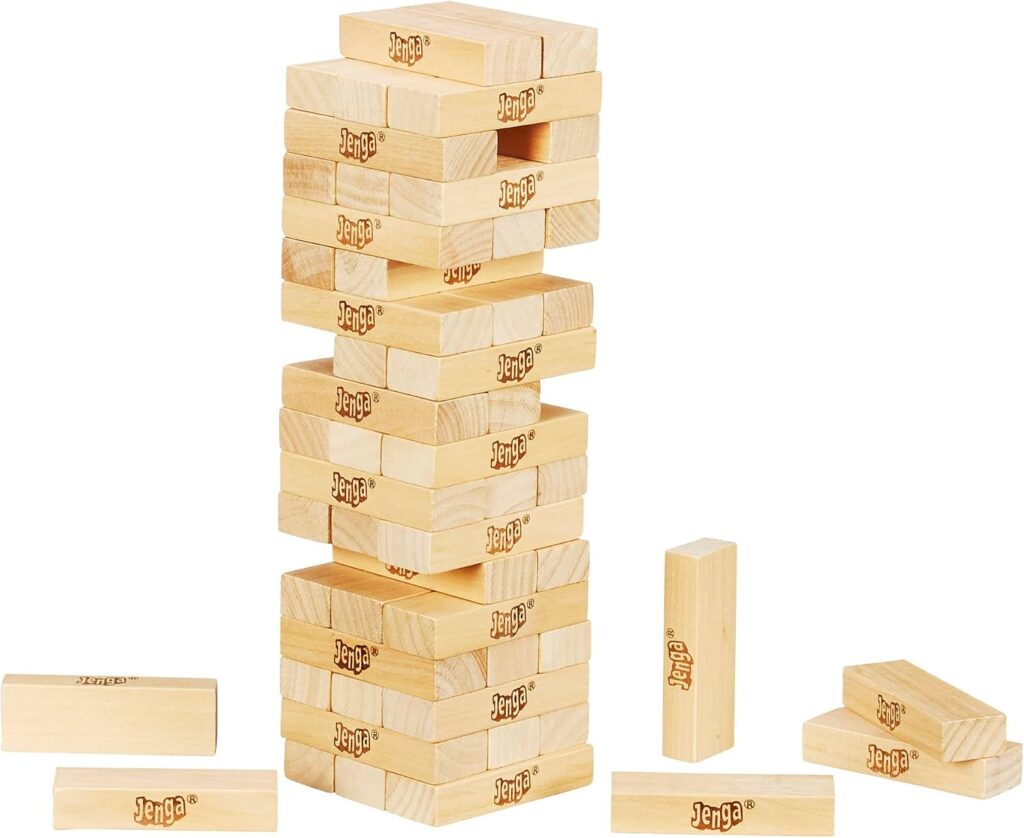
Jenga Classic keeps things refreshingly simple: build the tower, carefully remove one wooden block, place it on top, and try not to be the person who brings the tower down. With 54 hardwood blocks, a stacking sleeve, and rules that are easy to learn, it is designed as a quick physical game rather than a complicated strategy board game.
The biggest reason to consider it is its simplicity. You can explain the basic idea quickly and start playing without learning a long list of rules. The tradeoff is that anyone looking for a deeper game with cards, stories, character abilities, or changing objectives may find Jenga intentionally basic.
Jenga Classic at a Glance
| Game type | Wooden block stacking and balancing game |
|---|---|
| Blocks | 54 hardwood blocks |
| Recommended age | 6 years and up |
| Players | 1 or more players |
| Setup | Build the initial tower using the included stacking sleeve |
| Main objective | Remove blocks and stack them on top without making the tower fall |
What Is Jenga Classic?
Jenga Classic is one of those games where the entire idea can be explained in a few sentences. Players begin with a tower made from wooden blocks. Each level uses three blocks, with the direction changing from one level to the next.
Once the tower is ready, players take turns removing blocks and moving them to the top. The challenge becomes harder as the tower changes shape and its balance becomes less predictable.
Hasbro’s current product information lists 54 genuine hardwood blocks along with a stacking sleeve and instructions. The company also lists the Classic version for ages 6 and up and for one or more players. 1
How Does Jenga Actually Work?
The rules are straightforward, but the physical decision-making is where the game becomes interesting.
On a turn, the player chooses a block from below the highest completed level, carefully removes it, and places it on the top of the tower. The official rules specify using only one hand when moving a block. Players can also touch blocks to find one that appears easier to remove. 2
That creates a small but important decision every turn. You are not just asking, “Which block can I pull?” You are also thinking about what your move will do to the tower and what kind of position you are leaving for the next player.
Why Jenga Is More Interesting Than It Looks
On paper, Jenga can sound almost too simple. There are no complicated character powers, no deck of cards, and no long setup sequence. Yet the tower itself creates the changing challenge.
A block that looks like an easy choice can become a poor choice as the structure changes. The higher the tower grows, the more carefully players tend to approach their next move.
This is also why the game can feel different from one round to another. The rules stay the same, but the arrangement of the blocks changes, so players have to react to the tower in front of them rather than simply follow a fixed strategy.
Setup and Learning Curve
Setup is one of Jenga’s strongest practical advantages. The included stacking sleeve is designed to help assemble the initial tower. Once the tower is standing, the sleeve can be removed and the game begins. Hasbro describes the game as quick and easy to set up. 3
There is also very little for a new player to memorize. Someone unfamiliar with Jenga mainly needs to understand where they can remove a block, that the move is made with one hand, and that the removed block goes onto the top of the tower.
That low learning curve makes Jenga particularly useful when you have a mixture of experienced and inexperienced players. Nobody needs to spend a long time learning before joining the game.
What Makes the Wooden Blocks Important?
The physical blocks are not just the pieces used to represent the game. They are the game.
Hasbro describes this version as using 54 precision-crafted hardwood blocks. 4 Because players physically slide, lift, balance, and stack the pieces, the material and shape of the blocks directly affect the experience.
This is one reason Jenga feels different from many games played mostly with cards or tokens. Your hands are involved in every important decision.
Solo Play Is Possible Too
Jenga is commonly associated with groups, but the official product information lists it for one or more players. 5
Solo play changes the purpose of the game. Instead of trying to beat another player, you can treat the tower as your challenge and see how far you can build it before it falls. Hasbro’s official rules also describe a solo variation for trying to beat your own record. 6
That does not make solo play identical to playing with friends, but it gives the set another way to use the blocks when nobody else is available.
Pros and Cons
Pros
- Very easy to learn.
- Quick setup compared with many board games.
- 54 hardwood blocks provide the complete physical game.
- Works for solo play or groups.
- Creates tension naturally as the tower becomes harder to balance.
- Does not require batteries or a complicated game system.
Cons
- The gameplay is intentionally simple.
- It requires a suitable flat playing surface.
- Players looking for deep strategy may want a more complex game.
- The tower falling is part of the game, so pieces can end up scattered around the playing area.
Who Should Consider Jenga Classic?
Jenga Classic makes sense for someone who wants a simple game that can get people playing quickly. It is especially suited to players who enjoy hands-on games where balance, timing, and careful movement matter.
It can also make sense for households that do not want every game night to involve a long rules explanation. The basic gameplay is easy enough for new players to understand quickly, while the changing tower provides the challenge.
The manufacturer’s stated age recommendation is 6 years and up. As with any toy or game, that recommendation should be followed rather than assuming the product is appropriate for younger children. 7
Want to check the current Jenga Classic listing?
Check Jenga Classic on AmazonWho Might Want a Different Type of Game?
The same simplicity that makes Jenga accessible can also be its limitation.
If you prefer games with detailed strategies, changing objectives, large numbers of cards, storytelling, character development, or lots of different mechanics, Jenga may feel too straightforward.
It is better viewed as a physical balancing game with simple rules than as a strategy-heavy board game. That distinction is important when deciding what kind of game you actually want.
Is Jenga Good for Family Game Night?
The format works well when the goal is to get a game started without spending a significant amount of time explaining rules.
Players can watch the tower change during the game, and even people waiting for their turn can see how each move affects the structure. That makes the central action easy to follow.
Hasbro specifically positions Classic Jenga as a game for parties and game nights, as well as solo play. 8
What About Replay Value?
Jenga does not need dozens of different cards or scenarios to change from one game to another. The arrangement of the tower itself creates variation.
Every time blocks are removed, the structure changes. That means the next player is dealing with a slightly different situation, even though the rules have not changed.
The replay value therefore comes primarily from the physical challenge and the unpredictable tower rather than from unlocking new content.
Jenga Classic: Final Verdict
Classic Jenga is a good example of how a very simple game concept can remain engaging because of the way people interact with it. The objective is easy to understand, setup is relatively quick, and the tower itself creates the tension.
The official version includes 54 hardwood blocks and a stacking sleeve, with Hasbro listing it for ages 6 and up and one or more players. 9
The important thing is to buy it for what it actually is. Jenga is not trying to be a complicated strategy game. Its appeal comes from the physical challenge of carefully removing and stacking blocks while the tower becomes increasingly difficult to balance.
If that sounds like the kind of straightforward, hands-on game you want, Classic Jenga remains a very recognizable option. If you want a game built around deeper rules and more variety, you should look at a different type of board game instead.
Ready to see the current price and availability?
View Jenga Classic on Amazon