Candy Land Kingdom of Sweet Adventures Review
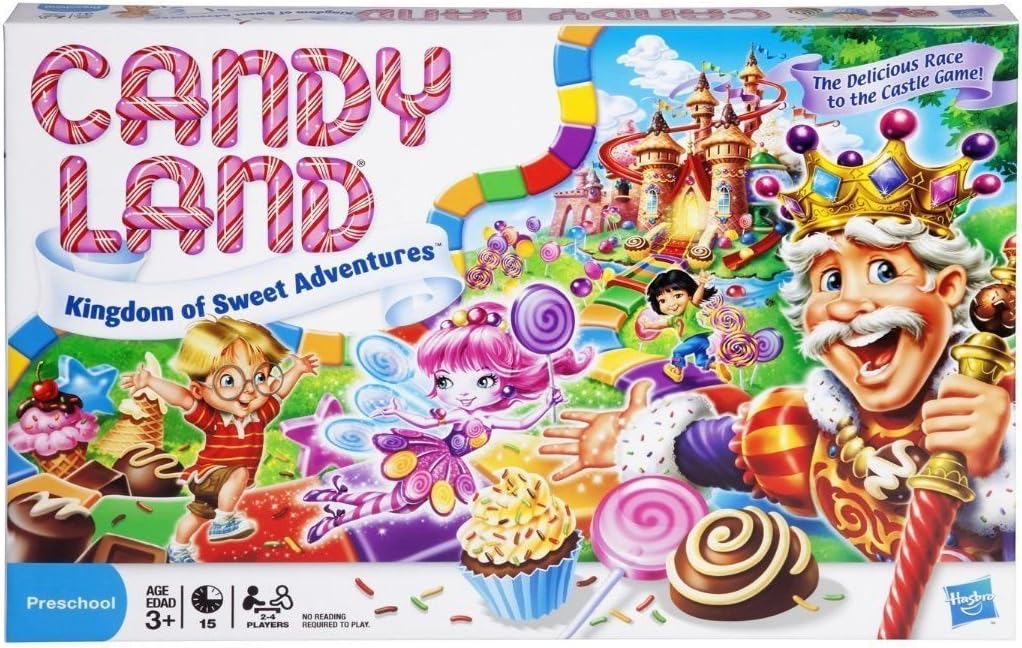
Quick take: Candy Land: Kingdom of Sweet Adventures is about as simple as a first board game can get. It uses colored spaces and cards instead of dice, numbers, or reading, making it accessible to preschoolers who are just learning how turn-based games work.
The important catch: there is very little strategy. Almost everything comes down to which card you draw, so its value is less about teaching complicated game strategy and more about giving young children an easy introduction to taking turns, matching colors, following a simple sequence, and handling the excitement of winning or moving backward.
Candy Land Kingdom of Sweet Adventures Review
For parents looking for a first board game for a 3 year old, the biggest problem is often not finding something colorful. It is finding a game that a preschooler can actually understand without needing an adult to explain complicated rules over and over.
That is where Candy Land has remained relevant for so long. The Kingdom of Sweet Adventures version keeps the central idea extremely straightforward: players move gingerbread character pawns along a colorful path toward the Candy Castle by drawing cards and matching the colors or characters shown on those cards.
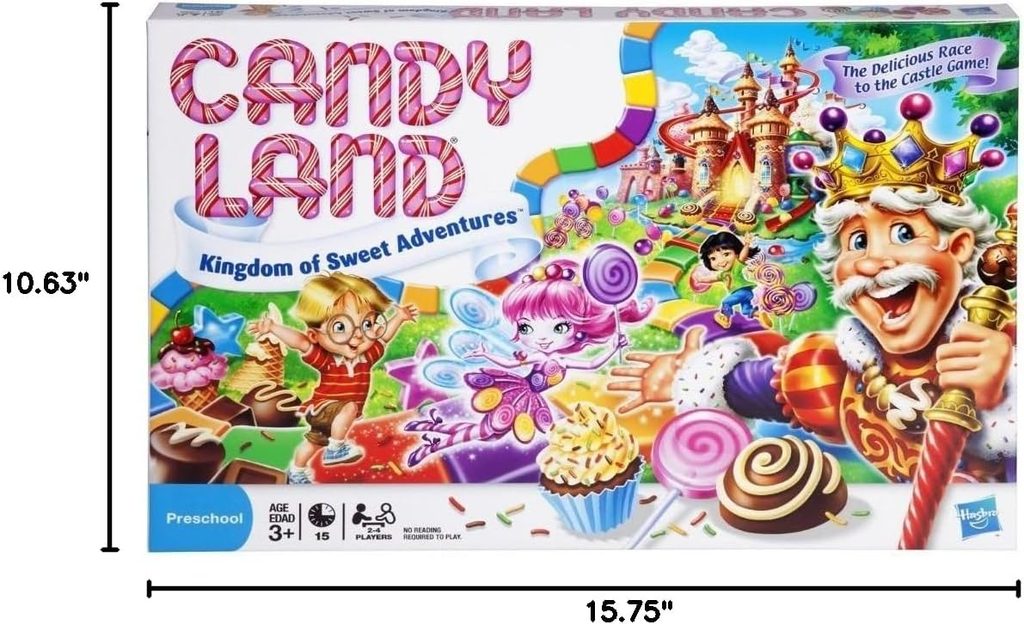
The version covered here is the Hasbro Gaming Kingdom of Sweet Adventures Amazon Exclusive, model 4700 S5, ASIN B00000DMF5. The listed package includes a gameboard, four gingerbread character pawns, a 64-card deck, and instructions. It is designed for 2 to 4 players and is recommended for children from about age 3. 0
Candy Land at a glance
- Recommended age: 3 years and up
- Players: 2–4
- Game type: Color/card-based racing game
- Reading required: No
- Pieces: Gameboard, 4 gingerbread pawns, 64 cards, instructions
- Typical play time: Around 15 minutes, although individual games can vary
How Candy Land Actually Works
The movement system is the main reason Candy Land works so well as an introduction to board games.
Instead of rolling dice and asking a young child to count several spaces, players draw cards showing colored spaces. A card with one color tells the player to move to the next space of that color, while a card with two matching color blocks sends the pawn to the second matching space ahead. Character cards can also send the player’s pawn directly to the corresponding location on the board. 1
That means a child can participate without knowing how to read and without being particularly confident with numbers. The board does most of the explaining visually.
For a preschooler, that simplicity is a genuine advantage. The child can look at the card, identify the color or picture, find the matching destination, and move the pawn. Those are small steps, but they introduce several of the basic habits needed for playing more complicated board games later.
Is Candy Land Good for a 3 Year Old?
It can be a good fit, especially for a child who is ready to start playing simple turn-based games. The official age range starts at 3, and the game does not require reading. 2
But I would not interpret “ages 3+” as meaning every three-year-old will immediately enjoy it independently. Preschoolers develop at different speeds, and some will need an adult to remind them whose turn it is, help identify colors, or explain why a special card moves them somewhere unexpected.
That is actually part of what makes Candy Land useful as a first board game. It gives parents an opportunity to practice the basic social rules of tabletop play without adding complicated game mechanics.
What a preschooler can practice
Color recognition, waiting for a turn, moving a game piece carefully, following a simple rule, accepting an unexpected result, and continuing after another player gets ahead.
The Biggest Weakness: There Is Almost No Strategy
This is probably the most important thing to understand before buying Candy Land.
You cannot really out-strategize another player. The game is driven by the cards you draw. A player who understands the rules perfectly can still lose to someone who happens to draw more favorable cards.
For adults, that can make Candy Land feel repetitive. For a three-year-old, however, the lack of complicated decision-making is part of the appeal. The child does not have to calculate probabilities, choose between several tactical options, or understand a long list of special abilities.
So I would not buy Candy Land because you want to teach advanced strategy. I would buy it because you want a simple, no-reading introduction to board-game routines.
What About the Frustration Factor?
This is where parents may have a slightly different experience from the child.
Candy Land can produce surprisingly dramatic swings because certain cards or board locations can move a player a long way. A child who thinks they are close to winning can suddenly find themselves much farther away.
That can be funny and exciting for one preschooler and extremely frustrating for another.
There is no need to pretend that this is a strategy lesson every time it happens. Sometimes the child will simply be disappointed. A parent can keep the first few games relaxed, remind everyone that the cards determine movement, and focus on learning how the game works rather than making winning the whole point.
If your child strongly dislikes games where luck can suddenly change the situation, this is worth considering before purchasing.
Does Candy Land Require Reading?
No, and that is one of its clearest strengths for preschoolers.
The movement cards rely on colors and illustrations rather than written instructions that a young child needs to read. That makes Candy Land accessible to children who are still learning their letters or have not started reading yet. 3
It also means an adult can explain the basic rules very quickly. Once the child understands the color-matching idea, the game can move along without someone constantly reading cards aloud.
Candy Land Board and Component Quality
For a game aimed at preschoolers, the physical components matter almost as much as the rules. A brilliant game becomes annoying if the board is awkward to unfold or the cards are difficult for little hands to manage.
This version includes a folded gameboard, four gingerbread character pawns, and a 64-card deck. 4 The pawns are deliberately simple rather than complicated miniature figures, which is appropriate for a first game where the child mainly needs to recognize which piece belongs to them.
The cards are the component I would pay the most attention to over time because they are handled every turn. Preschoolers are not always gentle shufflers, so parents should expect normal wear if the game gets played frequently. The manufacturer-style care guidance for this version recommends handling the cards and pieces carefully to avoid bending, tearing, or losing components. 5
In other words, I would consider Candy Land reasonably practical for its price and purpose, but I would not expect the components to behave like premium hobby-game materials.
How Long Does a Game of Candy Land Take?
The listed estimated playing time is about 15 minutes, although the actual length can vary because movement depends on the cards drawn. 6
That relatively short format is useful with preschoolers. A three-year-old does not necessarily need a 45-minute family game. A short round gives them enough time to practice the game without requiring them to sit still for an extended period.
It also makes Candy Land a reasonable choice for a quick indoor activity, an afternoon at home, or a short screen-free break.
Candy Land vs. Chutes and Ladders for 3 Year Olds
These games occupy a similar place in a preschooler’s game shelf: both are simple, luck-driven board games where children move pieces along a path and learn basic turn-taking.
The difference is in the visual and mechanical experience. Candy Land is built around colors, pictures, and a sweet-themed journey, while Chutes and Ladders uses numbered spaces and the familiar climb-and-slide mechanic.
For a child who is still developing confidence with numbers, Candy Land’s color-based movement can be the more straightforward system. For a child already comfortable counting spaces, Chutes and Ladders may offer a slightly different kind of practice.
Neither game provides much strategic choice, so the decision is largely about which theme and movement system your child will enjoy more.
The honest pros and cons
- No reading required
- Simple color-based movement
- Designed for ages 3+
- 2–4 players
- Short, easy-to-understand rounds
- Useful introduction to turn-taking
- Very little strategic decision-making
- Luck determines movement
- Backward moves can frustrate some children
- Cards can require careful handling with young children
- Older children may outgrow the simplicity
Is Candy Land a Good First Board Game?
If your definition of a first board game is something a preschooler can understand without reading, counting complex numbers, or learning a long rulebook, Candy Land makes a lot of sense.
The child chooses a pawn, waits for their turn, draws a card, finds the matching color or picture, and moves. That basic loop is easy enough for young children to grasp while still giving them an introduction to the social experience of sitting around a board with other people.
It is also worth remembering that “educational” does not have to mean academically difficult. Candy Land’s educational value is modest but practical: color recognition, following directions, turn-taking, patience, and learning that games do not always produce the result you wanted.
Who Should Buy It?
I would look at Candy Land if you are shopping for a first board game for a 3-year-old, a no-reading game for preschoolers, or a simple family activity that younger children can join without needing a complicated explanation.
It is especially sensible when the goal is to introduce a child to the basic routine of board games rather than immediately teach strategy.
I would be more cautious if you are buying for an older child who already enjoys strategic games. The simplicity that makes Candy Land approachable for preschoolers can also make it feel repetitive once a child wants meaningful choices during play.
Final Verdict: Candy Land Kingdom of Sweet Adventures Review
Candy Land survives for a simple reason: young children can understand it.
The game does not ask a preschooler to read, calculate complicated numbers, remember lots of rules, or make difficult strategic decisions. Instead, it gives them a colorful board, a handful of recognizable pieces, and a card system that tells them where to move.
That simplicity is both the product’s biggest strength and its biggest limitation.
For a three-year-old who is beginning to learn how board games work, the lack of strategy is not necessarily a problem. The child is learning how to wait, take a turn, follow instructions, move a piece, and deal with the fact that another player might get lucky. For an older child looking for a game where clever decisions matter, there simply is not much here to master.
So rather than calling it the “best” first board game for every preschooler, I would describe it more specifically: Candy Land is a straightforward, no-reading introduction to turn-based board games, with color matching and luck doing most of the work.
Bottom line: If you want a colorful, short, easy-to-explain game for ages 3+, Candy Land is a reasonable choice. If you want genuine strategy, meaningful choices, or a game that will challenge an older child for years, you should look beyond Candy Land.
The best reason to buy it is not the nostalgia or the colorful candy theme. It is the fact that a young child can actually participate.
Affiliate disclosure: This post contains affiliate links. If you purchase through one of these links, OzoneShip may earn a commission at no additional cost to you. Product details, pricing, availability, and packaging can change, so check the current Amazon listing before purchasing.