Hasbro Jenga Wooden Blocks Game Review: Is the Classic Stacking Game Still Worth Buying?
Every family seems to own one game that ends the same way — someone laughing, someone panicking, and thirty seconds of everybody holding their breath at once. For a huge number of households, that game is Jenga.
There are board games that need a rulebook, twenty minutes of setup, and one patient person willing to explain what everyone else is doing wrong. Jenga skips all of that. Build the tower. Pull one block. Set it on top. Try very hard not to be the person who brings the whole thing down.
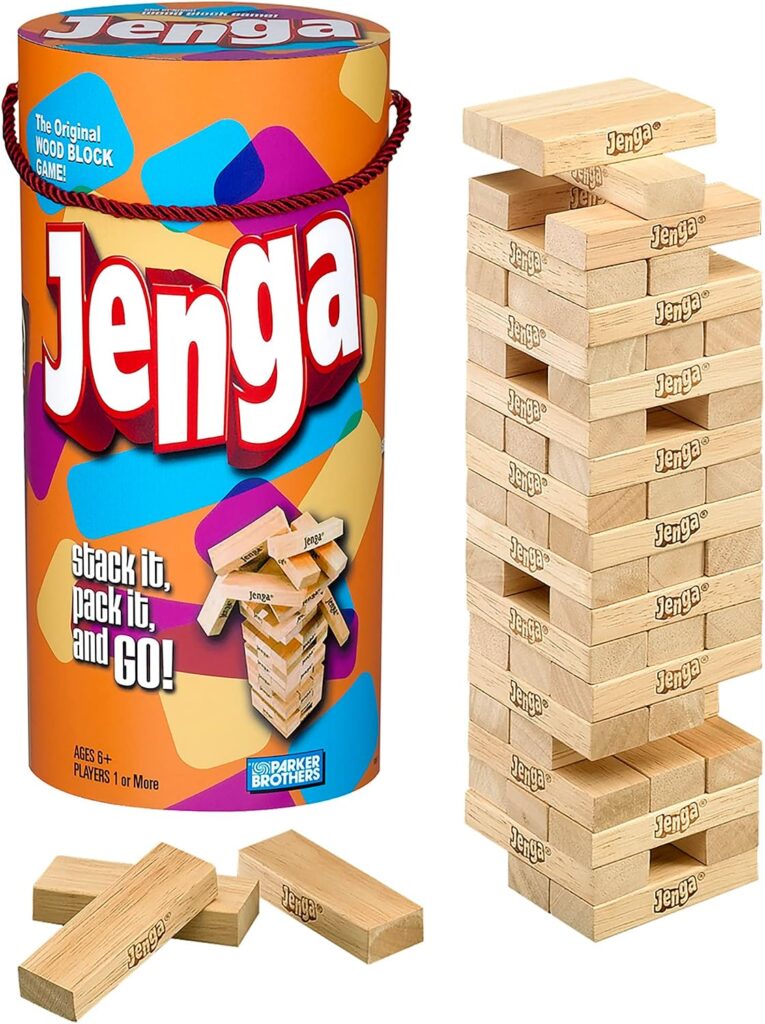
The Hasbro Gaming Jenga Wooden Blocks Stacking Tumbling Tower Game — this listing is for model 53557 — sticks to that exact formula: 54 hardwood blocks, a stacking sleeve, and a recommended age of 6 and up, which matches what Hasbro lists for the classic set. No app, no expansion pack, nothing to charge overnight. Just wood, gravity, and nerve.
Quick verdict
Classic Jenga is a strong pick for families, parties, mixed-age groups, or anyone who wants a game they can explain in under a minute. There’s nothing to read, nothing to memorize, no batteries to hunt for at 9pm. The tower simply gets more interesting with every turn, because every pull makes the next one riskier than the last.
The tradeoff is just as obvious: it’s mechanically simple. If you’re after deep strategy, a storyline, or real variety from one game to the next, this isn’t that game. For something fast, social, and low-effort, though, that’s not a flaw — it’s the entire point.
Best for: families, parties, kids 6+, adults who want something light, anyone who hates a steep learning curve.
Skip it if: you want a real strategy game, don’t enjoy dexterity or balance mechanics, or don’t have a stable table to play on.
Hasbro Jenga at a glance
| Feature | Details |
|---|---|
| Product | Hasbro Gaming Jenga Wooden Blocks Game |
| Brand | Hasbro Gaming / Jenga |
| Model number | 53557 |
| ASIN | B000GBA60W |
| Recommended age | 6 years and up |
| Players | 1 or more |
| Main components | 54 hardwood blocks |
| Setup tool | Stacking sleeve |
| Material | Wood |
| Batteries required | No |
| Gameplay style | Dexterity, balance, light strategy |
Who should buy this — and who shouldn’t
Jenga works especially well for people who don’t normally think of themselves as “board game people.” There’s no card combo to learn, no character sheet, no scoring system to track. You point at the tower and say “pull one out, put it on top, don’t knock it over,” and that’s the entire tutorial.
That makes it a natural fit for mixed-age family nights — a kid and a grandparent are playing under roughly the same rules, one just has steadier hands. It’s also a genuinely good party game, because you don’t have to be playing to be entertained. Watching a tower lean is basically its own spectator sport, and everyone in the room quietly becomes a structural engineer the second it starts to tip.
It suits:
- families with kids 6+
- birthday parties and holiday gatherings
- classrooms or activity rooms
- casual adult get-togethers where nobody wants a 90-minute strategy game
- solo players who just want to see how high they can build
It’s probably not for you if:
- you want a game with real strategic depth or replay variety
- you don’t enjoy games that depend on steady hands
- you need something playable in a moving car (a wobbly tower has enough problems without turbulence)
- noise is a concern — eventually the tower falls, and 54 wooden blocks hitting a hard floor are not subtle about it
How we researched this review
OzoneShip hasn’t personally tested this specific set, so treat this as a research-based guide rather than a hands-on review. For the facts, we checked Hasbro’s own product listing and official Jenga rules for model 53557 — the 54-block count, the stacking sleeve, the 6+ age range, and the one-or-more-players guidance all come from there, along with the rules for tower setup, legal block removal, the one-hand rule, and how a turn officially ends.
Specs and rules are easy to verify this way. How the blocks actually feel in your hand, how smoothly they slide, or how the set holds up after months of use — that we can’t tell you until someone here has actually played with this exact box.
What’s in the box
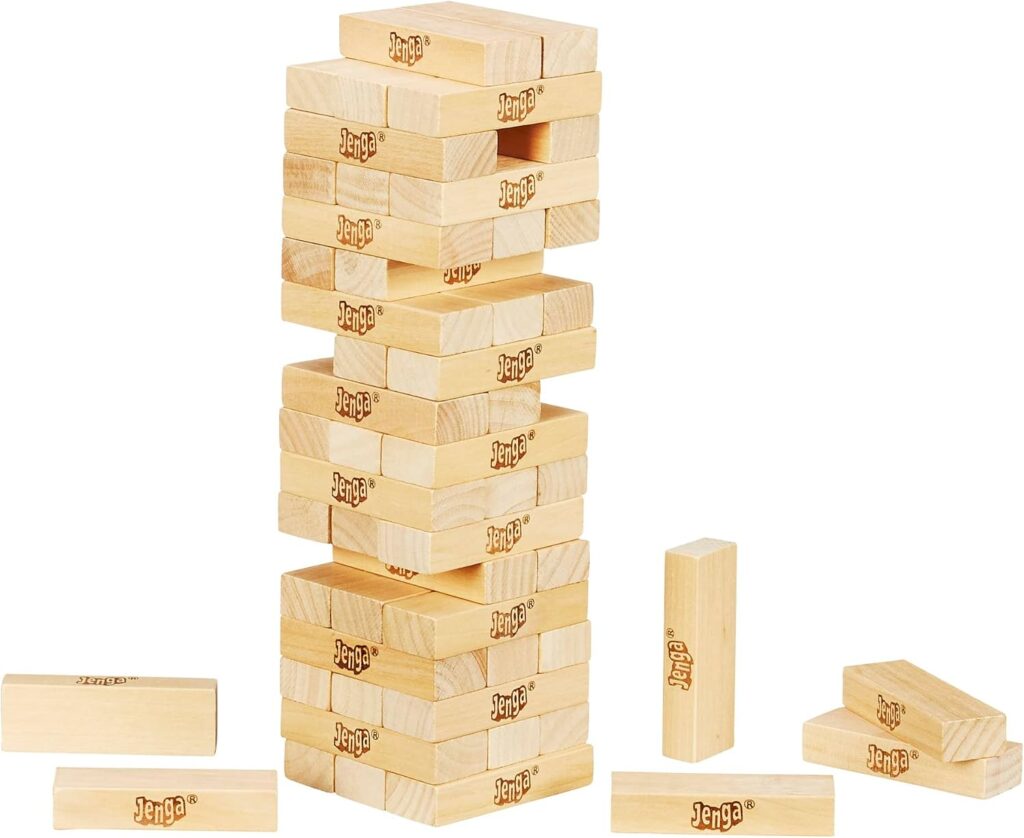
It’s refreshingly uncomplicated: 54 wooden blocks and a stacking sleeve to help you build the starting tower. All 54 blocks go into 18 levels of three, each level turned 90 degrees from the one below it — the standard Jenga setup, straight from the official rules.
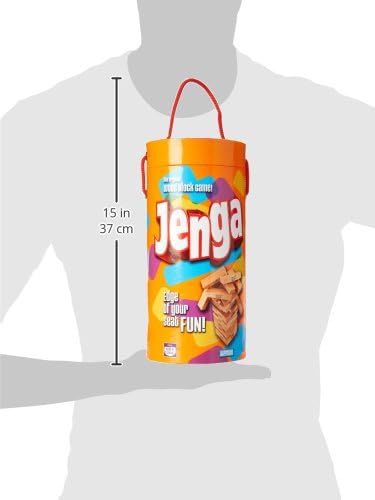
This particular listing ships in tube-style packaging designed to make it easier to store and carry, though packaging varies across Jenga editions, so it’s worth double-checking the current listing if that matters to you.
No dice, no board, no batteries, no tiny tokens to sort before you can even start. That’s most of why it’s stayed popular for as long as it has.
How to play Jenga
1. Build the tower. Three blocks per level, each level rotated 90 degrees from the last, for 18 levels total. Use the sleeve to keep it straight, and set it on a flat, stable surface — gravity doesn’t need any extra help.
2. Decide who goes first. By the official rules, whoever builds the tower starts, then play moves in order. For casual play, decide however you want.
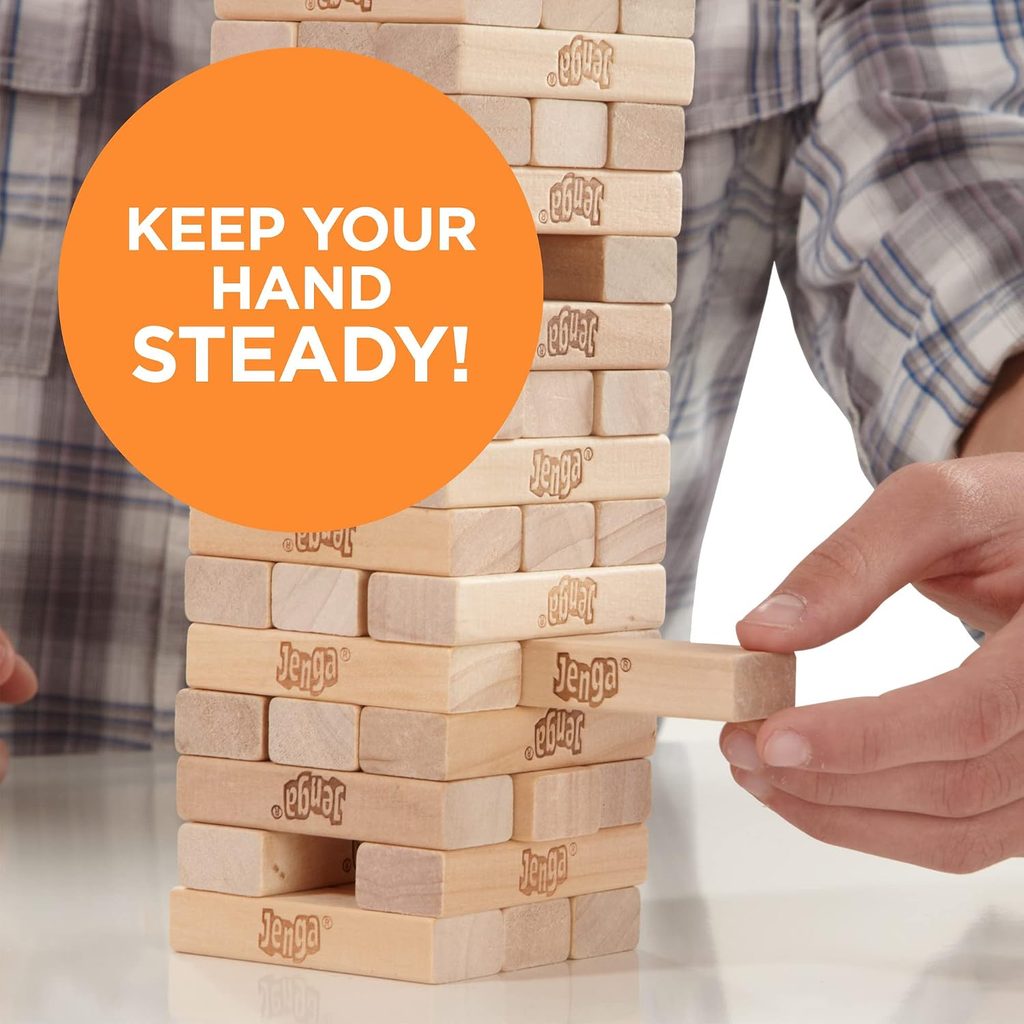
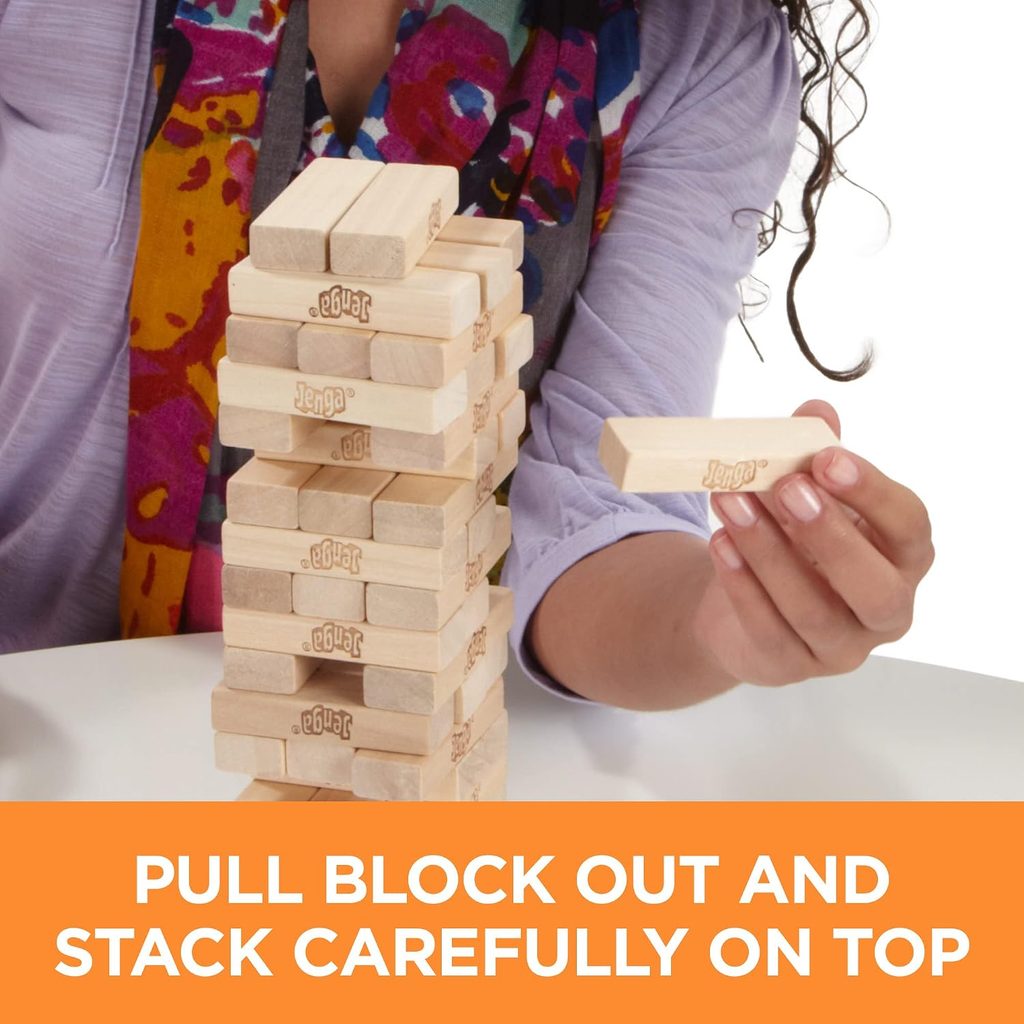
3. Remove one block. You can only pull from below the highest completed level — not from the top. And it’s one hand at a time; you can switch hands between turns, but you can’t brace the tower with one hand while pulling with the other. It would make the game much easier, which is exactly why it’s not allowed.
4. Test before you commit. You’re allowed to gently nudge a few blocks to find one that moves easily — just put back any block you touch but don’t take. A block that slides freely is probably safe. One that feels locked under the tower’s weight is telling you something.
5. Place it on top. Same rule applies going up: three per level, each level turned 90 degrees, one level finished before the next starts. Every move does two things at once — it weakens the tower somewhere below and adds height above, which is exactly why the game gets taller and shakier at the same time.
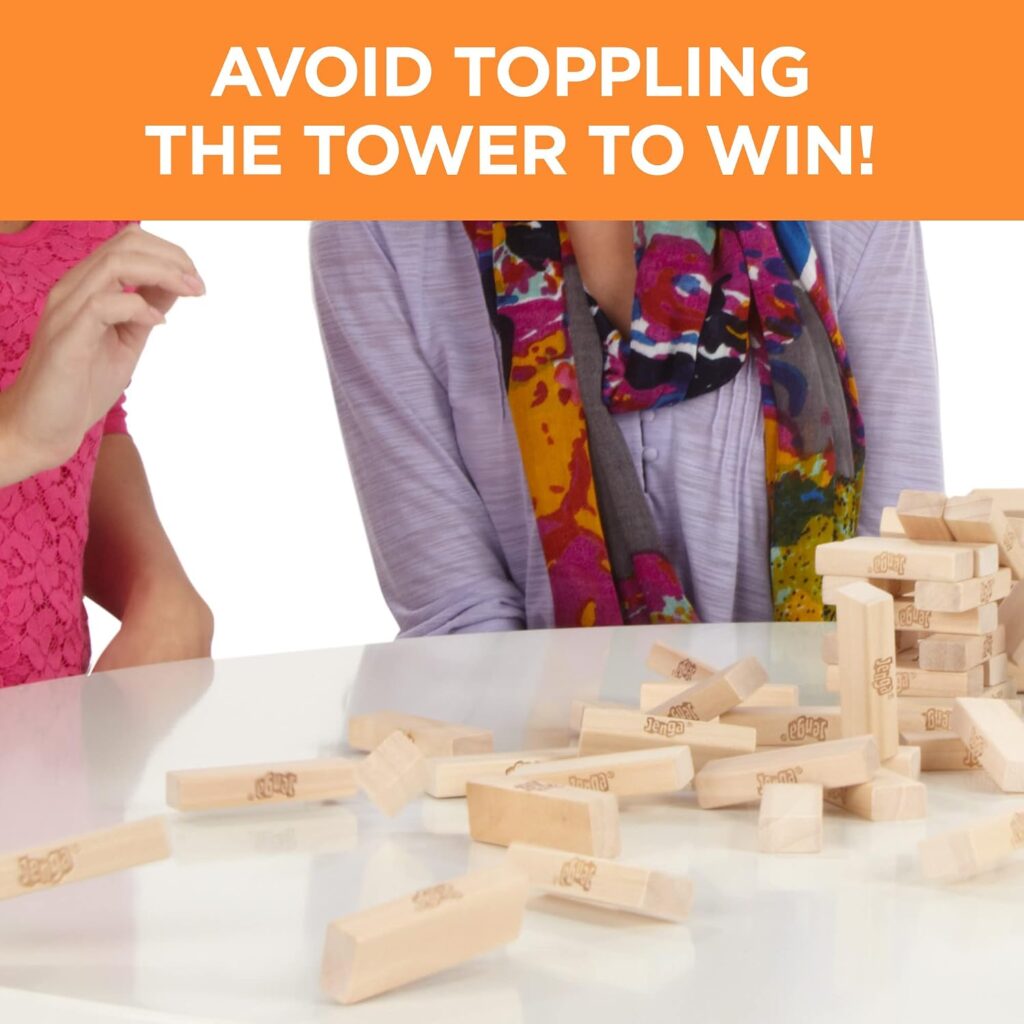
6. Don’t be the one who knocks it over. The winner is whoever completed the last turn before the tower fell. A turn officially ends the moment the next player touches the tower.
Can you play Jenga alone?
Yes — Hasbro lists it for one or more players. Solo, it becomes more of a personal challenge: keep pulling and restacking, and see how high you can get before it all comes down. You’re no longer trying to hand someone else a bad position. You’re just arguing with physics, and physics tends to win eventually.
Is there actually strategy here?
Calling Jenga a strategy game would be a stretch — steady hands matter more than anything else — but there’s more decision-making than people give it credit for. You’re reading which blocks look loose, how the tower is leaning, and what position you’ll leave the next player in. Sometimes the obviously loose block is the safe pick. Sometimes it isn’t, and you only find out two turns later.
A few habits help beyond just being careful:
- Test more than one block before committing — one usually moves noticeably easier than the rest.
- Watch the tower, not just your block — a piece can slide fine while the whole structure starts leaning above your hand.
- Push before you pull — nudging from one side can expose enough of a block to grip cleanly from the other.
- Smooth beats slow — stopping halfway through a move can leave the tower under awkward, uneven pressure. Controlled is better than glacial.
Is it good for kids? Adults? Parties?
For kids 6 and up, the appeal is that there’s almost nothing to read — just turn-taking, balance, and not knocking the tower over. It also quietly builds fine motor control and patience, though we’d stop short of calling it “educational”; that’s a side effect, not the marketing claim.
For adults, the draw is different: it doesn’t ask for mental effort, which makes it a strong choice while people are talking, eating, or drifting in and out of a party. Because the tower sits visibly in the middle of the table, people who aren’t even playing tend to get pulled in anyway.
For groups, Hasbro’s “one or more players” framing means there’s no hard player cap — turns just get slower as the group grows. It travels reasonably well thanks to the tube-style packaging, though “easy to pack” isn’t the same as “easy to play in a moving car.” You still need a flat, stable surface, which rules out cars, buses, and turbulence entirely.
What stands out
- The full 54-block set — not a scaled-down version.
- Near-zero learning curve — the simpler a game is to explain, the more likely it actually gets played.
- No batteries, nothing to charge or pair.
- The sleeve makes resets manageable — rebuilding 54 blocks by eye every round would get old fast.
Where it falls short
- The core loop doesn’t change. Remove, stack, repeat — no new cards or objectives to keep things fresh over dozens of games.
- Dexterity creates a real skill gap. Someone with steadier hands has a genuine edge.
- You need a stable, flat surface — no exceptions.
- It’s loud when it ends. This is not a quiet game.
- Resetting takes longer than learning the rules did, sleeve or not.
- Loose blocks wander, especially with kids around — one missing block isn’t a big deal, several is.
Pros and cons
Pros
- Very easy to learn
- 54 real hardwood blocks
- Works solo or in a group
- No batteries
- Strong party-game potential
- Kids and adults can play together with no separate rules
Cons
- Repetitive by design
- Needs a stable surface
- Dexterity affects outcomes more than decision-making does
- Resetting the tower takes real time
- Blocks can go missing over time
Classic Jenga vs other Jenga games
| Game | Main idea | Players | Age | Best for |
|---|---|---|---|---|
| Classic Jenga | Pull and restack blocks without toppling the tower | 1+ | 6+ | Simple, no-frills gameplay |
| Jenga with More Ways to Play | Same 54 blocks plus optional app-based challenges | 1+ | 6+ | Classic play with extra variety |
| Jenga Maker | Teams follow verbal instructions to build shapes (28 blocks, crown, 200 cards) | 2–6 | 8+ | Team communication games |
| Jenga Pass Challenge | 27 blocks on a handheld platform, passed between players with added challenges | 2+ | 8+ | Groups wanting a harder physical test |
If you just want “regular Jenga,” the classic 54-block version is still the right pick.
Amazon prices move around, so it’s not worth anchoring a review to one number. The better question is what you get for the complexity involved: 54 hardwood pieces, reusable indefinitely, no batteries, no expansions required, and a format that works whether it’s one player or a full table. If your household enjoys dexterity and social games, that’s a good trade. If nobody enjoys balancing games, 54 nicely organized blocks won’t change that. Check the current price and weigh it against other family games you’re considering, rather than trusting a number quoted in an old review.
Frequently asked questions
How many blocks are in Jenga? 54 hardwood blocks, arranged into an 18-level tower to start.
How many people can play? One or more — there’s no hard cap, though larger groups mean longer waits between turns.
What age is it for? 6 and up, per Hasbro’s recommendation.
Can you use two hands? Not at the same time — one hand per turn, though you can switch hands between turns.
Can you test blocks before choosing one? Yes, but any block you touch and don’t take needs to go back where it was.
Can you pull from the top of the tower? No — only from below the highest completed level.
Who wins? Whoever completes the last successful turn before the tower falls.
Can one person play? Yes — Hasbro supports solo play, where the goal is just building as high as possible before it collapses.
Does it need batteries? No, it’s entirely manual.
Is it a strategy game? There’s some strategy in reading the tower and choosing blocks, but dexterity matters more. Think “balance game with light strategy,” not “strategy game.”
Final verdict: is Hasbro Jenga still worth it?
Jenga has stayed popular for almost the opposite reason most games do — it hasn’t added anything. It’s still just 54 wooden blocks, one increasingly unstable tower, and a table full of people hoping someone else knocks it over.
For families, casual players, kids 6+, and party groups, that’s a genuinely solid combination: fast to teach, flexible on player count, no batteries required. If you want depth or variety, look elsewhere. If you want a game that goes from “this is easy” to “don’t touch the table” faster than you’d expect, classic Jenga still earns its spot on the shelf.
About the author: writes about family games, playing cards, toys, and screen-free entertainment for OzoneShip, focusing on what a product does well, who it’s actually for, and where it falls short.
Affiliate disclosure: This article contains affiliate links. If you buy through one of our links, OzoneShip may earn a commission at no extra cost to you. (If OzoneShip is enrolled in Amazon Associates, also add the required “As an Amazon Associate I earn from qualifying purchases” line to the site.)