Educational Insights Kanoodle Review: Is the TikTok-Viral Brain Puzzle Worth the Hype?
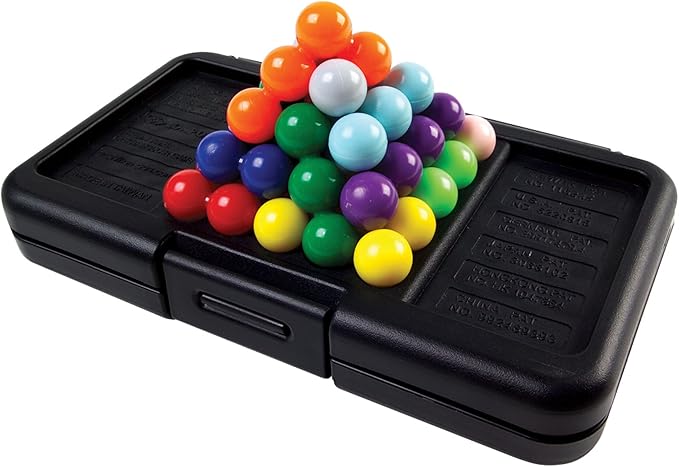
There’s a specific kind of quiet that happens when someone hands a Kanoodle puzzle to a kid, a teen, or an adult who “just wants to try one.” Five minutes later, they’re still turning the pieces over, muttering, refusing help. That’s more or less the entire pitch for this game: twelve small connected-ball pieces, a pocket-sized case, and a stubborn refusal to be solved on the first try.
Educational Insights Kanoodle has been around for years, but it picked up a second wind after going viral on TikTok — enough that the brand now advertises over nine million games sold and a running #KanoodleChallenge where players design and share their own puzzles. This listing is the Medium size, model EI-2978, and it’s a genuinely different kind of puzzle than a jigsaw or a word search: it’s spatial, it’s tactile, and it fits in a coat pocket.
Quick verdict
Kanoodle is a strong pick if you want a screen-free brain teaser that travels well and scales in difficulty from “kid learning shapes” to “adult genuinely stuck for twenty minutes.” The case doubles as the game board, the guide includes puzzles ranging from beginner to expert across both 2D and 3D layouts, and there’s no setup beyond opening the box.
The catch is that it’s a single-player game by design — this isn’t something you hand around a party table the way you would a card game. It’s closer to a portable Rubik’s Cube than a group activity.
Best for: kids 7+, teens, adults who like logic puzzles, road trips and waiting rooms, screen-free downtime, gift shoppers looking for something that isn’t a toy that gets outgrown in a month.
Skip it if: you want a group or party game, you’re shopping for a child under 3 (small-parts choking hazard), or you specifically want something that doesn’t require sustained concentration.
Kanoodle at a glance
| Feature | Details |
|---|---|
| Product | Educational Insights Kanoodle (3D Brain Teaser Puzzle) |
| Brand | Educational Insights |
| Model number | EI-2978 / 2978 |
| ASIN | B000FGECAI |
| Recommended age | 7 years and up |
| Players | 1 |
| Main components | 12 puzzle pieces, illustrated guide, carrying case |
| Puzzle formats | 2D and 3D configurations |
| Puzzle count | Guide includes puzzles ranging beginner to expert (listing references 228 challenges; product description references a 48-page guide with 200+ puzzles) |
| Material | Plastic |
| Batteries required | No |
| Warranty | 1 year against manufacturer defects |
Who should buy this — and who shouldn’t
Kanoodle sits in an unusual spot: it’s marketed as a kids’ toy, but a lot of its actual audience is teens and adults who like the same kind of satisfaction as a crossword or a Rubik’s Cube. The difficulty range is wide enough that both can be true at once — a younger kid can start with the beginner 2D puzzles in the guide, while an adult can work through the expert-level 3D pyramid builds and still get stuck.
It suits:
- kids 7 and up who enjoy shape-and-pattern puzzles
- teens and adults who like logic games, spatial reasoning, or fidget-adjacent brain teasers
- commuters, travelers, or anyone who wants something screen-free for downtime
- gift shoppers looking for stocking stuffers, birthday gifts, or classroom brain-break tools
- teachers wanting a quiet, self-contained activity for early finishers
It’s probably not for you if:
- you’re shopping for a child under 3 — the pieces are a documented choking hazard
- you want a multiplayer or party game, since this is built for one player at a time
- you’re looking for something with zero learning curve — the appeal here is that it’s genuinely challenging
How we researched this review
OzoneShip hasn’t personally tested this specific set, so this is a research-based guide rather than a hands-on review. The specs listed here — the 12-piece count, the 7+ age recommendation, the case dimensions, the 2D/3D puzzle formats, and the included illustrated guide — come from Educational Insights’ own product listing and description for model EI-2978. The listing’s bullet points cite 228 puzzle challenges, while the manufacturer’s product description references a 48-page guide with puzzles ranging from beginner to expert; we’ve noted both rather than picking one, since exact puzzle counts can vary slightly between print runs and editions.
What we can’t confirm without hands-on time is exactly how the pieces feel to manipulate, how the case holds up to daily travel use, or how quickly a specific age group progresses through the difficulty curve. Those details would need real testing.
What’s in the case
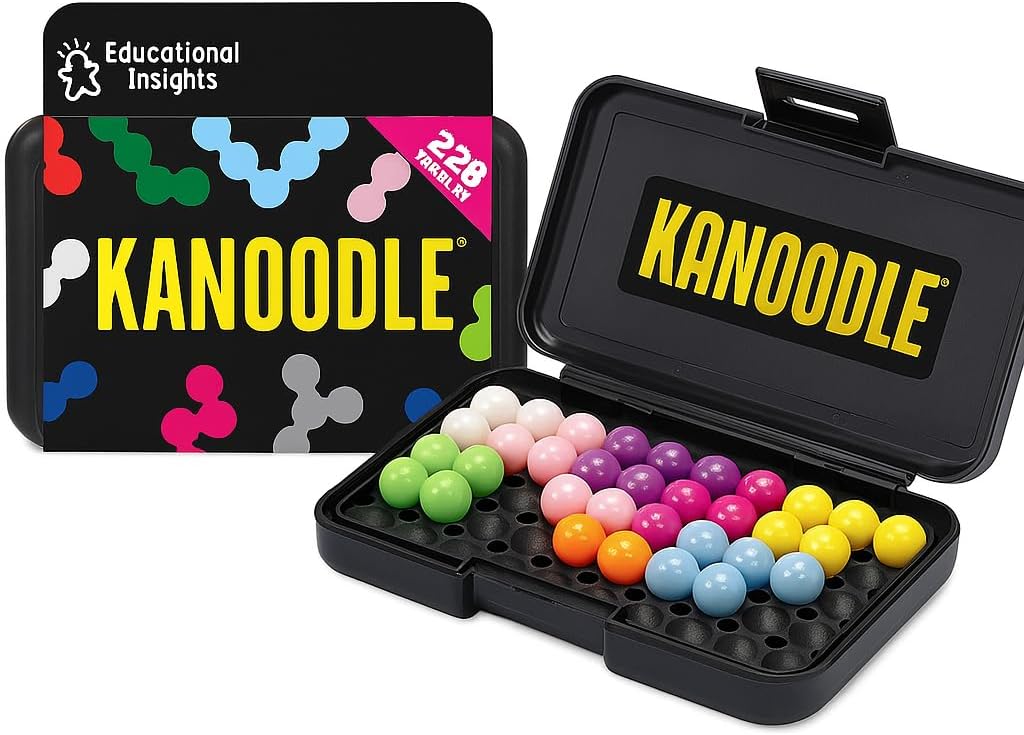
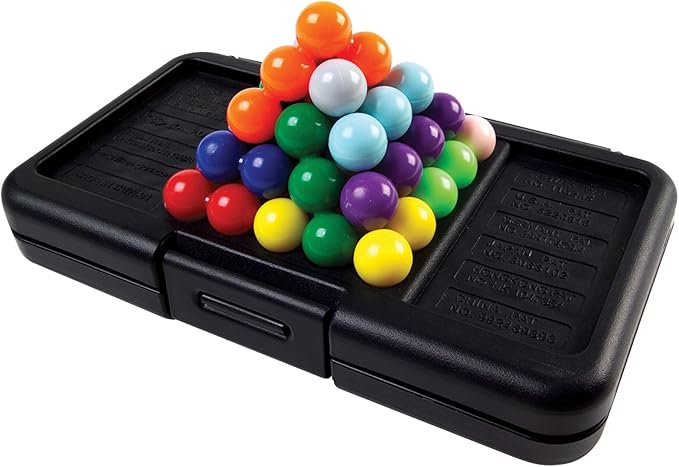
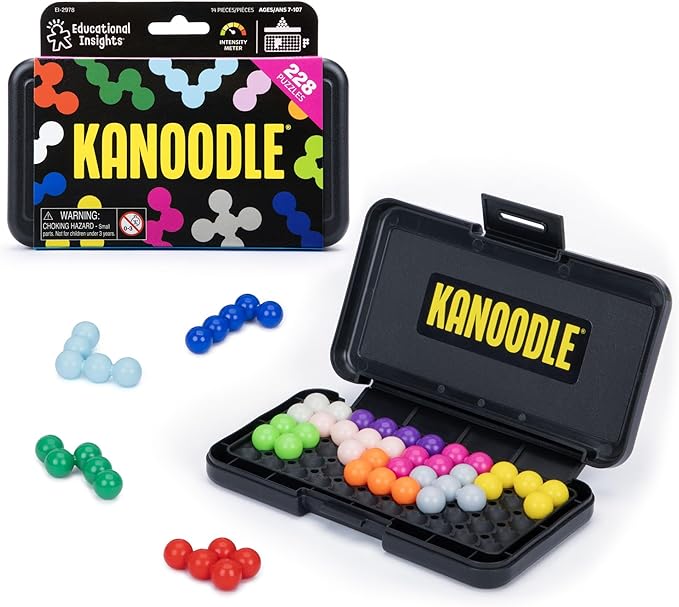
The set includes 12 colorful puzzle pieces shaped like connected spheres, a carrying case that doubles as the game board, and an illustrated guide with puzzles organized from beginner through expert. According to Educational Insights, the guide covers both flat 2D layouts and 3D pyramid-style builds, where pieces stack rather than lie flat.
The idea is simple on the surface: pick a puzzle from the guide, place the pieces shown as the starting configuration, and then fill in the remaining empty spaces using the rest of the set. The manufacturer notes there are hundreds of possible piece combinations, but only one arrangement actually completes any given puzzle — which is exactly what makes the harder levels frustrating in a genuinely satisfying way.
Because the case itself is the board, there’s no separate tray or mat to lose. Everything — pieces, guide, and board — packs into one pocket-sized container, which is a big part of why this thing shows up in backpacks, cars, and waiting rooms as often as it does at home.
How to play Kanoodle
1. Pick a puzzle from the guide. Puzzles are organized by difficulty, from beginner up through expert, across both 2D and 3D formats.
2. Set the starting pieces. Each puzzle page shows a partial arrangement — place the indicated pieces into the case’s grid (or stack them for the 3D pyramid puzzles) exactly as shown.
3. Fill the remaining space. Using the leftover pieces, figure out the one arrangement that completes the board without overlapping or leaving gaps.
4. Move up in difficulty. Beginner puzzles usually involve fewer pieces or simpler shapes to place; expert puzzles use the full set and tighter spatial constraints, especially in the 3D pyramid builds.
5. Try the #KanoodleChallenge. Beyond the guide, players are encouraged to design their own puzzle configurations and share them — part of why the brand caught on with a wider audience online.
Is it a group game?
Not really. Kanoodle is built for one player at a time, so it doesn’t replace a card or board game for a party table. Where it does work socially is as a pass-around challenge — one person solves a puzzle, hands it to the next person to try, and so on. It’s less “family game night centerpiece” and more “the thing everyone secretly wants a turn at.”
Is Kanoodle good for kids?
Educational Insights recommends this set for ages 7 and up, and that tracks with the reasoning skills involved — recognizing shapes, mentally rotating pieces, and working through trial and error without getting frustrated and walking away. It’s a genuinely screen-free way to build spatial reasoning and problem-solving, which is the manufacturer’s stated educational objective, though as with any “brain game” marketing, it’s worth treating that as a pleasant side effect rather than a guaranteed outcome for every child.
One important safety note: the packaging includes a choking hazard warning for small parts and specifically states the toy is not for children under 3 years and should be used under direct adult supervision at that age threshold. This isn’t a minor footnote — it’s printed directly on the product safety documentation, and it should be treated as a hard boundary rather than a suggestion.
Is Kanoodle good for teens and adults?
This is arguably where Kanoodle finds its real audience. The beginner puzzles are approachable for a 7-year-old, but the expert-level 2D and 3D challenges are genuinely difficult for adults — the kind of puzzle you pick up “for five minutes” and put down twenty minutes later, still not done. Because it’s compact and self-contained, it also works well as a low-effort alternative to phone scrolling during commutes, waiting rooms, or travel.
What stands out
- Difficulty range — beginner through expert puzzles mean it doesn’t get outgrown quickly.
- Genuinely portable — the case is the board, so there’s nothing extra to carry or lose.
- Screen-free — a real alternative to handing a kid (or yourself) a phone during downtime.
- Both 2D and 3D formats — more variety than a flat puzzle alone would offer.
Where it falls short
- Single-player only — not a fit if you’re looking for a group activity.
- Small parts pose a real choking hazard — not appropriate for children under 3, full stop.
- Progress depends on the individual — some puzzlers will fly through the guide, others will get stuck on early-intermediate levels for a while, which can be discouraging for a child without some adult guidance early on.
- Pieces can go missing — with 12 small parts and a compact case, keeping the full set together over time takes a little care.
Pros and cons
Pros
- Wide difficulty range, beginner to expert
- Compact, travel-friendly case doubles as the board
- Screen-free logic and spatial reasoning practice
- Both 2D and 3D puzzle formats included
- No batteries, no setup beyond opening the case
- Genuinely challenging for teens and adults, not just kids
Cons
- Built for one player, not a group game
- Choking hazard for children under 3 — small parts
- Difficulty curve can frustrate younger kids without guidance
- Small pieces are easy to misplace over time
Is it good value?
At a list price under $15 before any current discount, Kanoodle is priced closer to a stocking stuffer than a major gift purchase — but the puzzle count and difficulty range give it real staying power compared to a toy that gets solved once and forgotten. Since Amazon pricing and sale percentages shift, it’s worth checking the current listing rather than relying on a number quoted in a review. For the price point, a portable brain teaser with beginner-through-expert puzzles and a 1-year manufacturer warranty against defects is a reasonable bet, especially as a gift for someone who likes logic puzzles or needs a screen-free option for downtime.
Frequently asked questions
How many pieces come with Kanoodle? 12 puzzle pieces, along with an illustrated guide and a carrying case.
What age is Kanoodle recommended for? 7 years and up, according to the manufacturer. It is not intended for children under 3 due to small parts.
How many puzzles are included? The listing references 228 puzzle challenges, while the product description references a 48-page guide with puzzles ranging from beginner to expert — either way, there’s a wide range of difficulty to work through.
Can more than one person play at once? Kanoodle is designed for one player at a time, though it works well as a pass-around challenge among a group.
Is it a 2D or 3D puzzle? Both — the guide includes flat 2D layouts as well as 3D pyramid-style builds where pieces stack.
Does it need batteries? No, it’s entirely manual.
Is it a choking hazard? Yes — the packaging includes a small-parts choking hazard warning and states it is not intended for children under 3 years.
Is it good for travel? Yes — the compact case doubles as the game board, making it easy to bring along in a bag or car.
Final verdict: is Kanoodle worth it?
Kanoodle earns its viral moment honestly. It’s not flashy — it’s twelve small pieces and a case — but the puzzle design is genuinely clever, and the difficulty range means it doesn’t get solved once and shelved. For kids 7 and up, teens, and adults who like a real logic challenge, it’s an easy, screen-free way to fill downtime, and the portability means it actually gets used instead of sitting in a drawer.
If you’re shopping for a young child under 3, this isn’t the toy — the small parts make that a hard no. But for the audience it’s actually built for, Kanoodle is a small, inexpensive puzzle that’s harder to put down than it looks.
About the author: writes about family games, brain teasers, toys, and screen-free entertainment for OzoneShip, focusing on what a product does well, who it’s actually for, and where it falls short.
Affiliate disclosure: This article contains affiliate links. If you buy through one of our links, OzoneShip may earn a commission at no extra cost to you. (If OzoneShip is enrolled in Amazon Associates, also add the required “As an Amazon Associate I earn from qualifying purchases” line to the site.)