Educational Insights Kanoodle Review: What You Actually Get
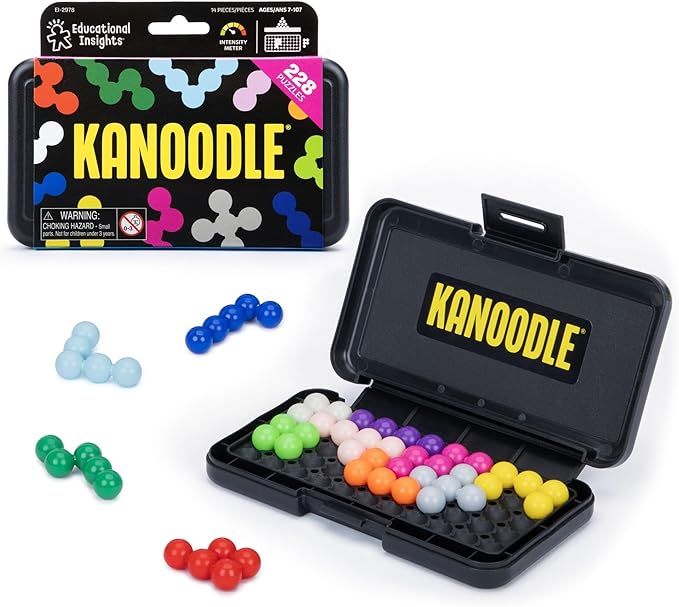
Quick take: Educational Insights Kanoodle is a compact, single-player logic puzzle built around fitting 12 connected pieces into 2D and 3D challenges. It is officially aimed at ages 7+, and the current product information lists more than 200 puzzles with difficulty ranging from beginner to expert.
What makes it interesting: this is not just another small toy that gives a child something to fiddle with. The main activity is actually solving the puzzle, so the appeal depends on whether the player enjoys thinking, trying different combinations, and sticking with a challenge.
Educational Insights Kanoodle Review: What You Actually Get
Kanoodle is one of those products that looks almost too simple at first. You get a compact plastic case, a group of colorful connected puzzle pieces, and a guide full of challenges. There is no electronic screen, no battery compartment, and no complicated setup.
The official product listing describes it as a single-player brain puzzle for ages 7 and up, with 12 puzzle pieces and 200+ challenges covering both 2D and 3D configurations. The case also doubles as the puzzle board and stores the pieces, which is a big part of the product’s usefulness. 0
That combination makes Kanoodle different from a traditional board game. There is no opponent to beat and no turn-taking. You simply choose a challenge, place the pieces shown in the guide, and work out how the remaining pieces fit into the empty spaces. The concept is easy to understand; the harder puzzles can take considerably more patience.
What is included?
The current Educational Insights version includes:
- 12 colorful Kanoodle puzzle pieces
- A compact carrying case that doubles as the game board
- An illustrated puzzle guide with 200+ challenges
- 2D and 3D puzzle formats
- Single-player play for ages 7+
How Kanoodle Actually Works
The basic idea is pleasantly straightforward. Pick a puzzle from the guide and look at the pieces already shown in the example. Your job is to figure out which remaining pieces belong in the open spaces and how they need to be positioned so the entire puzzle is completed.
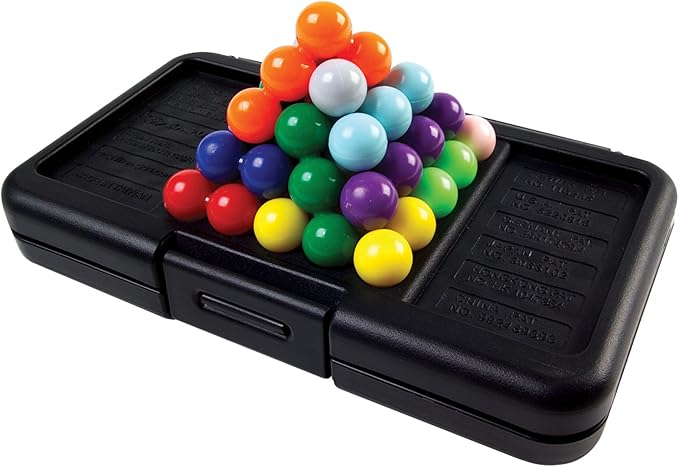
The 2D puzzles are the easier place to understand the game because everything is being filled into a flat board. The 3D pyramid challenges add another layer of spatial thinking because the pieces have to work together in a stacked shape rather than simply filling a flat outline. Educational Insights specifically describes Kanoodle as using both tricky 2D puzzles and 3D pyramid configurations at different difficulty levels. 1
That is also where Kanoodle earns its “brain teaser” reputation. The pieces are colorful and toy-like, but the actual challenge is about recognizing shapes, visualizing space, and testing combinations.
Is Kanoodle Good for 7 Year Olds?
The official recommendation starts at age 7, so a seven-year-old is within the intended audience. But age alone does not tell you whether a child will enjoy it.
A child who already likes puzzles, building activities, patterns, or figuring out how objects fit together may take to Kanoodle quickly. Another child of exactly the same age may find the tougher challenges frustrating and prefer to stop sooner. That is not really a flaw in the toy; it is simply how a progressive logic puzzle works.
For a seven-year-old, the smartest way to approach it is to start with the easier challenges and let the difficulty increase naturally. Educational Insights says the puzzles range from beginner to expert, so the game is designed to keep changing as the player improves. 2
A useful distinction for parents
Kanoodle is educational through the activity itself. It is not a workbook disguised as a toy. The child learns by manipulating the pieces, checking shapes, making mistakes, and trying another arrangement. That can make it much easier to reach for during a screen-free break than something that feels like extra schoolwork.
Kanoodle Original vs Kanoodle Genius
This is one comparison worth making because the names can make the two products sound almost identical.
The current Kanoodle Game is rated for ages 7+ and uses 12 pieces with 200+ puzzles. The Kanoodle Genius Game is aimed at ages 8+ and has 7 puzzle pieces with 202 advanced 2D and 3D challenges. Educational Insights positions Genius as a step up for players who have already mastered the original Kanoodle. 3
So the practical difference is not simply “old versus new.” The original is the broader entry point, while Genius is designed to push players who want a more advanced challenge.
Where Kanoodle Makes the Most Sense
One of Kanoodle’s strongest qualities is its size. The case is designed to keep the puzzle pieces together rather than leaving you with a pile of loose parts. Educational Insights specifically markets the compact case for travel, classroom brain breaks, restaurants, road trips, and other situations where portable screen-free entertainment is useful. 4
That makes it a natural fit for people searching for portable pocket brain games for road trips, compact travel puzzles with built-in storage, or a screen-free solo logic puzzle for kids.
It can also work well as a quiet activity in settings where noise and movement are limited. I would not describe it as a traditional “fidget toy,” though. The pieces are there to solve a puzzle, not simply to provide repetitive sensory play. That distinction matters when choosing something for a classroom, waiting room, or other quiet environment.
What I Like About Kanoodle
The biggest strength is the self-contained design. With many small puzzle games, the pieces are easy to lose and the board or cards take up more space than expected. Kanoodle takes the opposite approach: the case itself is part of the game and is also where the pieces are stored.
That makes cleanup simple, and it makes the product much more practical as a travel puzzle. You do not need a large table covered in components before you can start playing.
I also like the fact that the game has a real progression. A product that gives you ten nearly identical puzzles can feel repetitive very quickly. Kanoodle instead gives players a wide range of challenges, from easier arrangements toward much more demanding spatial puzzles. Educational Insights currently describes the game as having more than 200 challenges and difficulty from beginner to expert. 5
The part that matters most
Kanoodle gives the player a reason to keep trying. When the pieces almost fit but one part is still wrong, the puzzle creates the familiar “let me try one more time” feeling that good logic games are supposed to create.
What Could Be Better?
Kanoodle is not for every child, and that is worth saying clearly.
First, this is a one-player puzzle. If you are shopping for a game that siblings can play against each other or a family can sit around together, this is not that type of product. It is much closer to a portable solo brain teaser than a traditional family board game. 6
Second, the challenge can become genuinely difficult. That is a benefit for puzzle fans, but a younger child who expects a fast, easy win may get frustrated. The product works best when the player is comfortable with trial and error rather than expecting every challenge to be solved immediately.
And while the packaging is compact, the pieces are still relatively small. Educational Insights includes a small-parts warning and says the product is not for children under 3. 7
Is It Really a Good Travel Puzzle?
This is probably one of the easiest questions to answer: the design is genuinely travel-friendly.
The pieces stay with the case, the game does not require batteries, and the whole concept is based around opening the case, choosing a challenge, and solving it. Educational Insights specifically promotes the pocket-sized format for on-the-go use. 8
That makes it more convenient than many puzzle toys where you have to carry a separate board, a box of pieces, and cards that can disappear into the bottom of a bag.
For airplanes, road trips, restaurants, waiting rooms, or simply keeping a child occupied without a phone, this format makes sense.
How Does It Compare With the “Educational Toy” Label?
This is another area where I think it helps to be realistic. Kanoodle is clearly designed around spatial reasoning, problem-solving, and critical thinking, and Educational Insights explicitly describes those as benefits of the game. 9
But that does not mean buying the puzzle automatically improves a child’s skills just because it sits on a shelf. The value comes from actually using it. A child who enjoys working through the challenges can get a lot more from it than a child who dislikes logic puzzles.
That is why I would place Kanoodle in the category of learning-through-play rather than calling it a substitute for formal learning.
Is Kanoodle Worth Considering as a Gift?
For the right child, yes. The appeal is particularly easy to understand for parents looking for screen-free solo logic puzzles for kids, compact brain games for elementary-school children, or something small enough to take on trips.
The product is also currently listed by Educational Insights as a bestseller, and an Amazon price-tracking page reported the Amazon listing as #1 Best Seller in Assembly & Disentanglement Puzzles in September 2026. That ranking can change, so I would treat the badge as a snapshot rather than a permanent measure of the product. 10
The more important question is whether the recipient actually likes this kind of challenge. For a puzzle-loving 7- or 8-year-old, it can make sense as a birthday present or stocking-stuffer-style brain game. For a child who mainly wants social play, action, or imaginative play, another type of toy may fit better.
Who should look at Kanoodle?
A good fit: puzzle-loving kids ages 7+, tweens, teens, and adults who enjoy solo spatial challenges and screen-free activities.
Think twice: shoppers looking for a multiplayer family game, a very easy first puzzle, or a toy primarily meant for sensory/fidget play.
Final Thoughts on the Educational Insights Kanoodle Review
Kanoodle works because it keeps the idea simple. There are colorful pieces, a compact case, a challenge guide, and one clear objective: figure out how everything fits.
What makes it more interesting than a basic shape puzzle is the range of challenges. The same set of pieces can be used for 2D arrangements and 3D pyramid puzzles, and the difficulty can move from beginner-level problems to challenges that require much more careful spatial thinking. 11
I would not describe Kanoodle as universally entertaining, because solo logic puzzles naturally appeal more to some people than others. But for someone who enjoys that “almost solved it” feeling, the combination of portability, replayable challenges, and simple storage is a very sensible package.
It is also the kind of product where the buyer should focus on the person receiving it, not just the bestseller label. If the child likes puzzles and enjoys figuring things out independently, Kanoodle has a strong reason to be on the shortlist. If they want a game with friends, this particular version is not designed around that.
Bottom line: Educational Insights Kanoodle is a compact 1-player brain teaser for ages 7+ with 12 pieces, 200+ challenges, 2D and 3D formats, and a case that keeps the set together. Its biggest advantage is that it combines real puzzle solving with a genuinely portable design. 12
For a puzzle-loving child or adult who wants a quiet, screen-free challenge, it is easy to understand why this format has remained popular.
Affiliate disclosure: This post contains affiliate links. If you purchase through one of these links, OzoneShip may earn a commission at no additional cost to you. Product details, age recommendations, and features can change, so check the current Amazon listing before purchasing.